
Nikro Air Duct Repair in Providence: A Homeowner’s Guide
A shop-vac generates roughly 1 – 2 inches of water column pressure. A Nikro negative-pressure machine generates 100 or more. That gap is the difference between stirring debris around inside your ducts and actually pulling it out of your house. Most homeowners comparing duct cleaning quotes in Providence have never been told which machine will show up, so the low bid looks identical to the professional one on paper. It isn’t. Here’s how to tell them apart before anyone sets foot in your basement.
What does a Nikro negative-pressure machine actually do?
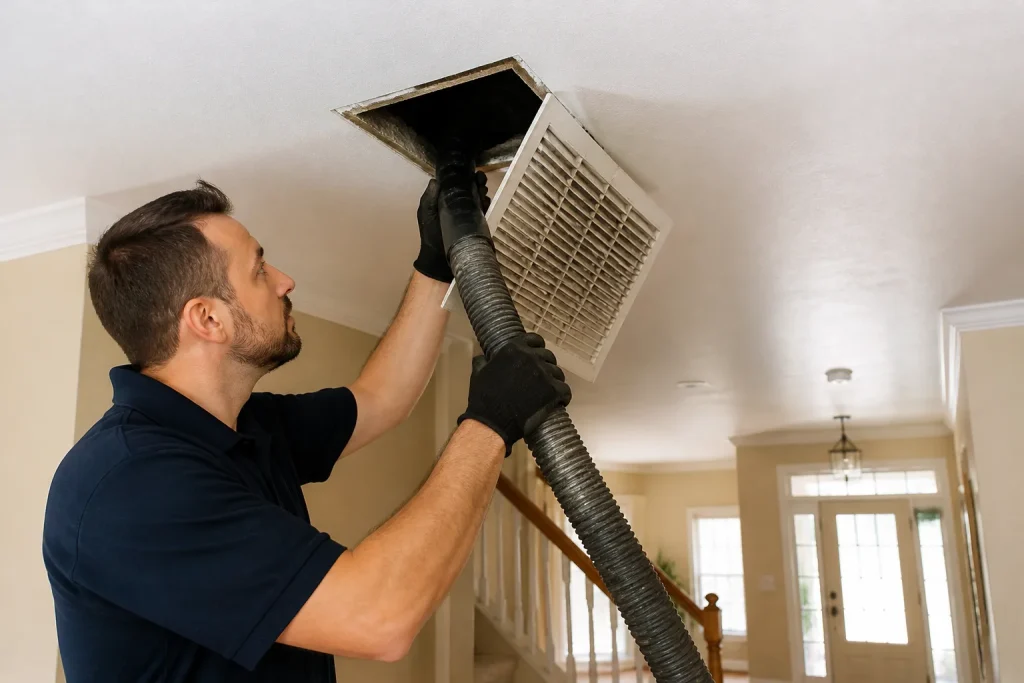
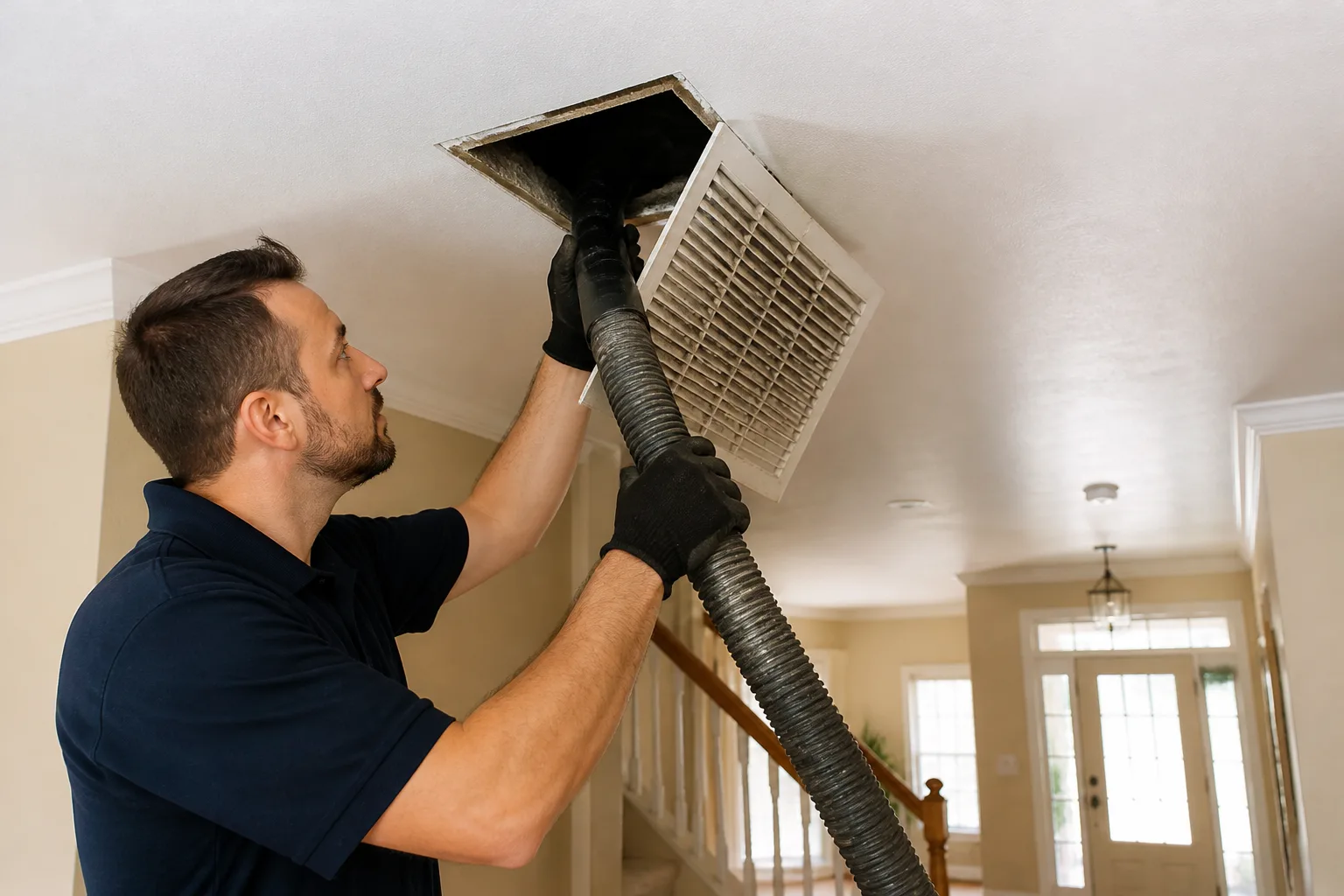
It changes the pressure inside your duct system so debris has one place to go: into the collection unit. Instead of blowing compressed air around and hoping the dust settles somewhere convenient, a Nikro machine hooks up to the ductwork, drops the pressure below the surrounding rooms, and holds it there while the ducts are agitated with a contact-cleaning tool. Loose debris moves toward the machine because physics says it has to. That’s the whole idea, and it’s the reason professionals use the word “extraction” rather than “cleaning.”
The pressure differential matters most over the length of a run. A short branch off the main trunk is easy for almost anything to clear. But the long, winding returns common in Providence’s older triple-deckers and converted multi-families are where weak suction loses its grip and debris simply resettles a few feet downstream. Negative pressure holds across that whole distance. In our experience, that’s exactly where a homeowner can hear the difference: a properly set-up system produces a steady, low drone from the collection unit, not the frantic whine of a tool fighting a losing battle.
If the ducts themselves are damaged or disconnected, though, no amount of suction saves you. That’s why we treat air duct cleaning and duct repair as one conversation, not two.
Why containment matters as much as suction
Pulling debris out of the ducts is half the job. Keeping it out of your living room while you do it is the other half, and this is where a lot of budget operations quietly fail. When seals break, joints come loose, or the technician cuts an access hole in the wrong spot, all that loosened material has somewhere to escape. For a household with allergies, or a kitchen still dusted with drywall powder from a recent renovation, a sloppy extraction can leave the air worse than it started.
Abatement Technologies HEPA filtration is built for this exact problem. Attached to the negative-pressure unit, it captures fine particulate at the exhaust end so what comes out of the machine is filtered air, not a cloud. In a Providence home, that matters most in three situations:
- Post-renovation debris. Drywall dust and construction grit are fine enough to slip past ordinary filters and stay airborne.
- Heavily contaminated systems in older housing. Decades of accumulated dust in an aging duct system needs controlled extraction, not a gust of air.
- Health-sensitive households. If someone in the home has asthma or serious allergies, containment isn’t optional.
Ask any contractor whether they run HEPA filtration during the job. If the answer is vague, that’s your answer. Better air starts with better equipment, and the equipment should be named, not gestured at.
What a correctly set-up Nikro system looks like in a Providence home
You don’t need to be an HVAC technician to judge a setup. You just need to know what normal looks like. Here’s what you should notice, and what you definitely should not.
- An access point at the main trunk. The collection unit connects where the system carries the most volume, usually near the air handler or furnace, so it can pull from the whole house rather than one branch.
- Isolated zones. Registers get sealed off so the machine pulls through the ducts, not from the rooms. If every vent is left wide open, the pressure differential collapses and you’re paying for theater.
- A steady, even sound. The machine should run at a constant low tone. A system that surges, stutters or sounds like it’s gasping is telling you something is wrong with the setup or the seals.
- No dust haze. You should not see visible dust in the air while work is happening. That’s the containment test, in plain sight.
- A collection canister you can inspect. Before and after. This is your proof the work produced something.
Once extraction is underway, the technician works through each branch with a contact-cleaning tool, like a Rotobrush system, to loosen what’s stuck to the duct walls as the negative pressure carries it away. We like to walk homeowners through the setup while it’s running, because understanding the machine is how you stop getting fooled by the next quote.
The scenarios where negative pressure is non-negotiable
Not every home needs the full stack. But some situations leave no room for a shop-vac and a handshake, and a Providence homeowner should know which ones they’re in before the estimate conversation.
Post-renovation debris is the clearest case. Drywall dust, sawdust and construction grit get pulled deep into returns during a remodel, and they don’t settle politely. Controlled extraction with HEPA containment is the only way to clear them without redepositing them across your furniture.
Heavily contaminated systems in older housing are the second. Providence has a lot of housing stock where ducts have gone decades without real attention, and the accumulated load is substantial. Weak suction disturbs that load and leaves most of it behind. Negative pressure removes it.
Any follow-up work after mold treatment in an HVAC system calls for the same discipline: containment and extraction, so disturbed material doesn’t become an indoor air quality problem mid-job.
If your ducts are also leaking, crushed or disconnected, the sequence matters. Repair first where needed, then clean, because a broken duct can’t hold a pressure differential. We find what’s wrong and fix it on the same visit wherever the system allows, which is the whole point of handling Providence air systems as repair and cleaning together.
What to ask any duct cleaner about their equipment
Before you book anyone, ask these questions. A professional answers them without flinching; the wrong contractor gets vague fast.
- What pressure does your machine pull? Ask for the model. Nikro negative-pressure equipment is a standard you can verify.
- Do you run HEPA containment? Abatement Technologies equipment is the industry benchmark here, and the answer should be yes for any sensitive household.
- Will you show me the collection canister before and after? Refusing this is a red flag. The canister is your before-and-after photo, in person.
- Can you repair damaged ductwork, or only clean it? A one-task vendor can’t fix what a cleaning reveals.
It’s also fair to ask about filtration upgrades once the ducts are clean. We work with Honeywell and Aprilaire filtration products, and a filter that matches your system does more for long-term air quality than another cleaning a year later. That said, we’d rather you ask the equipment questions first. The machine doing the extraction is what determines whether the job works at all.
When to call a pro
If your vents push out visible dust when the system kicks on, if a recent renovation left grit in the returns, if someone in the house is having breathing trouble that gets worse indoors, or if you’ve never had the system looked at and your home is older, it’s time. Duct repair that uncovers a disconnected run is worth catching before it dumps conditioned air into a crawlspace all winter. And dryer vents belong on the list too: your dryer vent is a fire hazard waiting to be cleared, and dryer vent cleaning is a safety service, not an upsell. It’s one of the few jobs where the stakes are genuinely high if it’s ignored.
When you call, ask what machine comes out and whether HEPA containment is part of the setup. That single question filters out most of the shop-vac crowd.
The Bottom Line
Negative pressure isn’t a marketing phrase; it’s a measurable physics advantage, and it’s the thing to verify before you sign off on any duct cleaning quote in Providence. Look for named equipment (Nikro for extraction, Rotobrush for contact cleaning, Abatement Technologies for HEPA containment), sealed zones, an inspectable collection canister, and a contractor who can repair what they find. If you’re in Providence and need help, Duct Cleaning Providence offers free estimates. Call (844) 542-8739. We answer 24/7. Fast dispatch from 7am to 7pm, Sunday through Friday. Our technicians have up to 13 years of experience, and we handle Duct Cleaning Providence along with repair and dryer vent service under one roof.
Frequently Asked Questions
Whole-system cleaning is priced per job by a written estimate, not per vent, so the number depends on your system’s size, layout and condition. A written estimate is free, and it sets the final price before any work starts. Call (844) 542-8739 for an exact quote.
Cheap quotes usually come from underpowered equipment, skipped containment work, or per-vent pricing that adds up fast once the technician arrives. If the quote doesn’t name the machine or mention HEPA filtration, it’s likely a shop-vac operation. Call (844) 542-8739 for an estimate that names the equipment.
Ask to see the collection canister before and after, and watch that the zones are sealed during the job. Visible dust in the air during cleaning is a red flag. Call (844) 542-8739 and we’ll walk you through the setup before we start.
Most homes do fine every few years, but a recent renovation, an older system, or a household with allergy sufferers moves that schedule up. A healthy system that’s never been cleaned in an older Providence home is worth a look sooner rather than later. Call (844) 542-8739 for a free estimate.
Written by the team at Duct Cleaning Providence.
Need Air Duct Cleaning Help?
Call Duct Cleaning Providence - licensed & insured, with free written estimates in Providence.
(844) 542-8739